
Your domain name is one of the most important decisions you'll make when building an online presence. It's the first thing people see in search results, the address they type into their browser, and the foundation of your digital brand. Yet many businesses rush through this decision — or settle for whatever's available — without understanding the lasting impact a domain name has on growth, trust, and discoverability.
In this guide, we'll break down exactly why a good domain name matters and how to choose one that sets your business up for long-term success.
Why Your Domain Name Matters More Than You Think
Before a visitor reads a single word on your website, they see your domain name. It shows up in Google search results, social media shares, email signatures, business cards, and word-of-mouth recommendations. A clean, memorable domain instantly signals professionalism — while a long, confusing, or hyphenated one raises doubts before the page even loads.
Research from Microsoft found that users form an opinion about a website within 0.05 seconds. Your domain name is a significant part of that snap judgment. Would you trust best-deals-online-shop-2024.net the same way you'd trust shopify.com? The domain sets expectations for everything that follows.
Think of your domain as your digital storefront sign. In the physical world, nobody walks into a shop with a misspelled, barely readable sign. The same principle applies online — your domain is the sign above your door.
How a Good Domain Name Builds Your Brand
Your domain name is often the very first branding decision you make. It becomes your identity — the name people type, search for, recommend to friends, and remember months later. A strong domain name is an extension of your brand, not a technical afterthought.
Consider the biggest brands online: google.com, stripe.com, notion.so, linear.app. Each domain is short, distinctive, and immediately associated with the product. That's not a coincidence — it's a deliberate branding strategy.
What Makes a Domain Name Brandable?
- Short (under 15 characters). Fewer characters means fewer typos, easier recall, and better fit on business cards and social profiles. Studies show that the average top-100 website domain is just 6.3 characters long.
- No hyphens or numbers. They're hard to communicate verbally ("Is that dash or underscore? The number 4 or the word four?") and they look spammy to users and search engines alike.
- Easy to pronounce and spell. If someone hears your domain in a podcast or conversation, can they type it correctly on the first try? If not, you'll lose traffic to typos.
- Unique and distinctive. Avoid generic words that blend in with competitors. A distinctive name is easier to trademark, easier to rank for, and easier to build a brand around.
- No trademark conflicts. Before committing, search the USPTO database and do a basic Google search to make sure your domain doesn't overlap with existing brands. Legal disputes over domains are expensive and disruptive.
Domain Names and Credibility: Why Trust Starts in the URL Bar
Online trust is fragile. Users decide in seconds whether a website looks legitimate, and the domain name is one of the strongest trust signals available. A professional domain tells visitors you've invested in your online presence and that you take your business seriously.
This matters even more for businesses handling sensitive information — e-commerce stores processing payments, SaaS companies storing user data, healthcare providers, and financial services. A domain like mystore.com inspires far more confidence than mystore.freewebhost.biz.
A Stanford Web Credibility Research study found that 75% of users judge a company's credibility based on their website design — and the domain name is the very first element of that design. Free subdomain addresses, overly long URLs, and obscure TLDs all erode trust before a visitor even sees your content.
Signs of an Untrustworthy Domain
- Free subdomains (yourname.wordpress.com, yourname.wixsite.com)
- Excessive hyphens or numbers (best-cheap-deals-4-u.net)
- Misspelled words or character substitutions (amaz0n-deals.com)
- Obscure or unfamiliar TLDs that users don't recognize
How Your Domain Name Affects SEO
While Google has moved away from giving exact-match domains a direct ranking boost, your domain name still has a significant indirect impact on SEO. Search engine optimization isn't just about keywords — it's about user behavior signals, and your domain influences several of them.
The SEO Signals Your Domain Name Influences
- Branded search volume. When people search for your domain name directly (e.g., "domhaul" or "domhaul domain finder"), Google treats this as a strong authority signal. A memorable domain generates more branded searches.
- Click-through rate (CTR) in search results. A clean, professional domain in Google results gets more clicks than a messy one. Higher CTR tells Google your result is relevant, which can improve your rankings over time.
- Backlink acquisition. Other websites are more likely to link to a domain that looks trustworthy and authoritative. Quality backlinks remain one of the most powerful ranking factors.
- Direct type-in traffic. A memorable domain means visitors come directly by typing your URL, reducing dependence on paid ads and signaling to search engines that you're a destination site.
- User engagement metrics. Users who trust your domain are more likely to stay, browse multiple pages, and return later — all positive signals that correlate with higher rankings.
How to Choose the Right TLD (.com, .io, .co, and More)
The TLD (top-level domain) is the extension at the end of your domain — .com, .io, .co, and so on. While .com remains the gold standard for broad appeal and universal trust, the domain landscape has expanded significantly. Choosing the right TLD depends on your audience, industry, and goals.
TLD Comparison: Which Extension Should You Choose?
- .com — The default. Best for broad, global appeal and maximum trust. If the .com is available for your brand name, take it.
- .co — Short and modern, popular with startups. Used by companies like angel.co and loom.co. Good alternative when .com is taken.
- .io — Widely used in tech and developer communities. Carries a "tech-forward" connotation. Used by github.io, itch.io, and many SaaS products.
- .app — Enforces HTTPS by default. Great for software products and mobile applications.
- .dev — Ideal for developer tools, portfolios, and documentation sites. Also enforces HTTPS.
- .ai — Increasingly popular for AI and machine learning products. Premium pricing but strong relevance in the AI space.
- Country TLDs (.uk, .de, .ca, .com.au) — Useful if your audience is in a specific country. Can help with local SEO in that region.
The Long-Term Value of a Good Domain Name
A good domain is a business asset that appreciates over time. Every day your website is live, your domain accumulates authority, backlinks, search engine trust, and brand recognition. This compounding value is why domain changes are one of the most disruptive things a business can do.
Changing your domain later means losing years of built-up SEO equity, breaking every backlink pointing to your site, confusing your existing customers, and essentially starting over in the eyes of search engines. The redirect process is imperfect — studies show that even properly executed domain migrations can result in a 10-30% traffic loss that can take months to recover.
Premium domains regularly sell for thousands or even millions of dollars — voice.com sold for $30 million, insurance.com for $35.6 million — because their owners understand this compounding value. You don't need to spend millions, but investing a little more thought and money upfront to secure the right domain will pay dividends for years to come.
Common Domain Name Mistakes to Avoid
Knowing what not to do is just as important as knowing what to do. Here are the most common mistakes people make when choosing a domain name:
- Making it too long. Every extra character increases the chance of typos and makes the domain harder to remember. Aim for under 15 characters.
- Using trendy slang or misspellings. What feels clever today ("flickr", "tumblr") can feel dated tomorrow. Misspellings also mean you'll constantly be correcting people.
- Choosing something too similar to a competitor. You'll leak traffic to them, confuse customers, and potentially face legal issues.
- Not checking social media availability. Your domain and social handles should ideally match. Check Twitter/X, Instagram, and other relevant platforms before committing.
- Ignoring international audiences. If your domain is hard to spell or pronounce in your target markets, you'll lose traffic internationally.
- Settling too quickly. Your domain is a long-term commitment. Spend time brainstorming, checking availability, and getting feedback before you buy.
How to Check if a Domain Name Is Available
Once you have a shortlist of domain name ideas, you need to check if they're actually available for registration. Traditional domain registrars let you check one name at a time, which is tedious when you're exploring dozens of options.
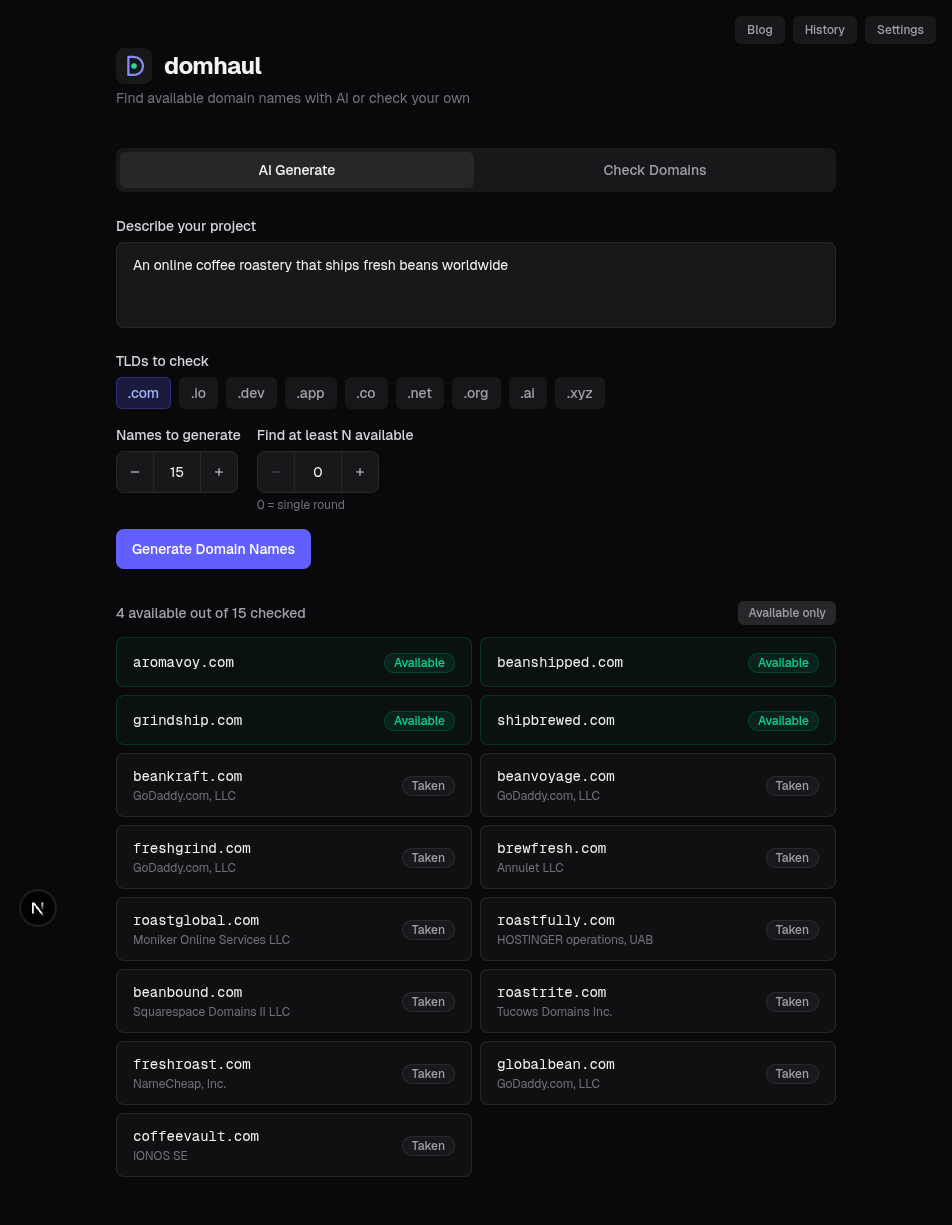
A faster approach is to use an AI-powered domain name generator that can brainstorm creative names based on your description and check availability in real time. This saves hours of manual searching and surfaces options you might never have thought of.
Frequently Asked Questions About Domain Names
How much does a domain name cost?
Most standard domain names cost between $10 and $20 per year through registrars like Namecheap, Google Domains, or Cloudflare Registrar. Premium or highly sought-after domains can cost significantly more — anywhere from hundreds to millions of dollars on the aftermarket. New TLDs like .io or .ai tend to be pricier, typically $30-90 per year.
Can I change my domain name later?
Technically yes, but it's strongly discouraged. Changing your domain means losing accumulated SEO authority, breaking existing backlinks, confusing returning visitors, and updating every mention of your old domain across the internet. Domain migrations typically result in a 10-30% traffic loss. It's much better to invest time choosing the right domain upfront.
Is .com always the best choice?
.com is the most universally trusted and recognized TLD, so it's the safest default choice. However, alternatives like .io (for tech), .co (for startups), .app (for software), and country-specific TLDs can work well if they fit your brand and audience. The key is choosing a TLD your target audience trusts.
Does my domain name affect my Google ranking?
Not directly — Google doesn't give ranking bonuses for specific keywords in your domain. However, your domain name indirectly affects SEO through branded search volume, click-through rates, backlink acquisition, and user trust. A memorable, professional domain improves all of these metrics, which correlates with better rankings over time.
What's the difference between a domain name and web hosting?
A domain name is your website's address (e.g., example.com) — it's what people type to find you. Web hosting is the server where your website's files are stored. You need both to have a website: the domain is the address, and the hosting is the building at that address. They're purchased separately, often from different providers.
How do I come up with a good domain name?
Start by brainstorming words related to your brand, product, or industry. Keep it short (under 15 characters), easy to spell and pronounce, and free of hyphens or numbers. Check for trademark conflicts and social media availability. Use an AI-powered tool like domhaul to generate creative options based on your description and check availability instantly.
Start Finding Your Perfect Domain Name
The best time to secure a great domain is now — good names get taken every day, and the longer you wait, the fewer options you'll have. Whether you're launching a startup, building a side project, or establishing a personal brand, your domain name is the foundation of your entire online presence.
Don't settle for a domain you're not excited about. Take the time to find one that's short, memorable, and perfectly aligned with your brand — it's one of the highest-ROI investments you can make.